Free Ground Shipping on Orders Over $49 Details & Exclusions Excludes Curb Side Delivery (LTL). Lower 48 United States Only. • Shop The Latest Lookbook

Jun 12, 2026
3-Blade vs. 5-Blade Ceiling Fans: Does Blade Count Matter?
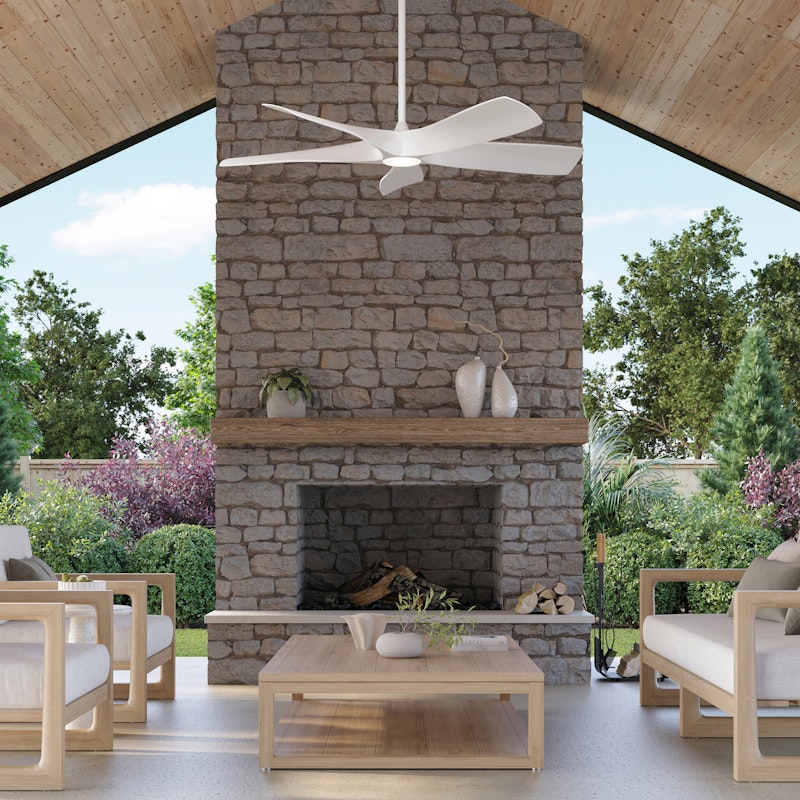
Vernal 60 Inch Ceiling Fan with Light Kit by Progress Lighting
When you’re designing spaces in your home, it’s like curating an art gallery. From your living room furniture to the fixtures suspended overhead, each piece must be hand-selected with intention and purpose.
For example, the right ceiling fan does more than just circulate air. It acts like a kinetic sculpture, casting dynamic shadows while anchoring the room’s aesthetic with a warm, metallic finish or the rich texture of carved wood. But when you’re faced with the functional decisions of interior design, a common question often comes up. Should you choose a 3-blade or 5-blade ceiling fan?
The choice between 3-blade vs. 5-blade fans comes down to physics, aerodynamics, and visual balance. By understanding how each type of fan works, you can select one that blends better with your home’s artistic vision and comfort needs.
Do More Fan Blades Mean Better Airflow?
Choosing the ideal fan for your space begins not with a myth, but with a better question. Instead of asking only, “How many blades does it have?” Ask whether this fan is the right size, style, and build for my room. A helpful way to think about it: blade count is like the silhouette of a light fixture. A chandelier and a pendant can both illuminate a room beautifully—but they tell different design stories.
One of the biggest misconceptions in the 3-blade fan vs. 5-blade fan debate is that more blades always mean more air. In reality and practicality, blade count alone is not a reliable measure of performance. The number of blades is not necessarily an indicator of airflow; blade pitch, blade shape, motor performance, and fan size all play a major role in how a fan feels in everyday use.
The two main factors to consider when determining which ceiling fan moves more air are the motor’s strength and the blade pitch, or the angle at which the blades are tilted. A high-quality motor that’s paired with perfectly tilted blades can move a massive amount of air, regardless of whether it has three blades or five. In fact, adding more blades to a ceiling fan can sometimes increase the aerodynamic drag. The motor must work harder to push a five-blade assembly through the air than it does with a three-blade fan.
A beautifully engineered 3-blade fan can move air impressively, while a poorly matched 5-blade fan may feel underwhelming in the same room. Think of blade count as one design feature in a larger composition. It contributes to the look and feel of the fan, but it is not the whole performance story.
Blade tile also plays a role in a ceiling fan’s performance. The blades must be tilted at an angle to push or pull air down rather than just cut through it. Most blades are tilted at only a slight angle of around 12 to 15 degrees, which is just enough for optimal airflow.
You should also look for reversible fans. In the summer, the blades push air downward to cool the air. In winter, you can adjust the direction to create updrafts that distribute heat throughout the room, making it warmer.
Designer insight into why this works: Airflow is measured in cubic feet per minute (CFM), which tells you exactly how much air a fan moves per minute at its highest speed setting. A fan’s ability to maximize its CFM rating relies on the delicate balance between the weight of the blades and the torque of the motor.
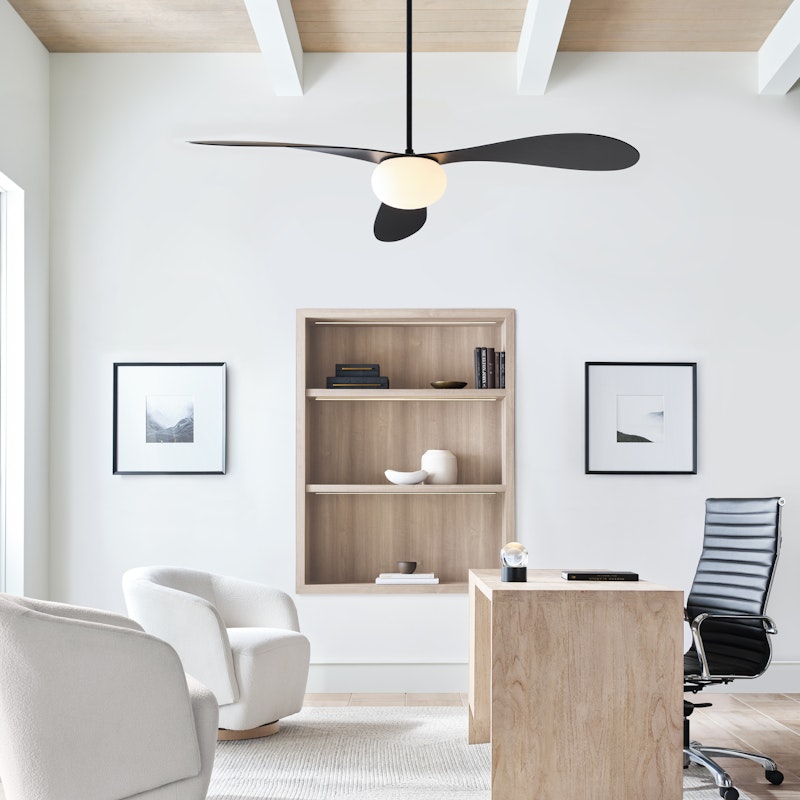
Peter Bristol Drape Smart 58 Inch Ceiling Fan with Light Kit by Visual Comfort Fan Collection
Key Differences Between 3-Blade and 5-Blade Ceiling Fans
In practical terms, the difference between a 3-blade and 5-blade ceiling fan usually comes down to aesthetics, room feel, and the engineering behind the fan itself. When you’re comparing two high-quality fans, focus less on the blade count in isolation and more on the overall design. A well-made fan — whether it has 3 or 5 blades — should feel smooth, stable, and integrated into the design.
Comparison Table: 3-Blade vs 5-Blade
| Feature | 3-Blade Ceiling Fan | 5-Blade Ceiling Fan |
| Overall look | Sleek, sculptural, modern | Fuller, more classic, more traditional |
| Visual impact | Minimal and streamlined | Traditional and balanced |
| Airflow feel | Can feel strong and direct when well-designed | Can feel smooth and comfortable when well-designed |
| Best style match | Modern, contemporary, transitional spaces | Traditional, farmhouse, coastal, classic interiors |
| Perception of movement | Often more dynamic and architectural | Often softer and more conventional |
As a general design rule, 3-blade fans tend to lean more modern, while 5-blade fans often suit traditional or transitional rooms. The design of 3-blade fans tends to be sleek and refined, while 5-blade fans are commonly associated with a more classic look.
A 3-blade fan tends to be lighter because there is less physical material creating drag, so the motor encounters less resistance. This allows 3-blade fans to spin faster, enabling them to cut through the air more quickly and creating a more concentrated, direct downdraft.
On the other hand, 5-blade ceiling fans have more surface area, which makes them slightly heavier. With more weight and less space between the blades, it means the motor must work harder to keep spinning. Also, because the blades are closer together, the air is scooped and pushed in a more consistent, overlapping manner. Rather than a sharp, fast breeze, a 5-blade fan tends to create a softer breeze throughout the entire space.
Comparing Airflow Performance and Efficiency
When considering which ceiling fan moves more air, the answer is: the better-engineered fan for that specific room.
A ceiling fan’s airflow is usually measured in CFM (cubic feet per minute), but comfort is influenced by more than just one number. CFM tells you how much air is moved, while airflow velocity helps describe what you actually feel. In addition, the wind-chill effect creates that cooling sensation, which is why blade shape, pitch, and motor performance matter so much in ceiling fan airflow comparisons.
That means:
- A 3-blade fan is not automatically more powerful
- A 5-blade fan is not automatically more efficient
- The right blade span for the room often matters more than blade count
- A high-quality motor and smart blade design can outperform assumptions based on blade number alone
If you are comparing two similar fans, focus on the full picture: room size compatibility, motor quality, airflow ratings, and mounting type. That is the best path to finding the best ceiling fan blade count for your home.
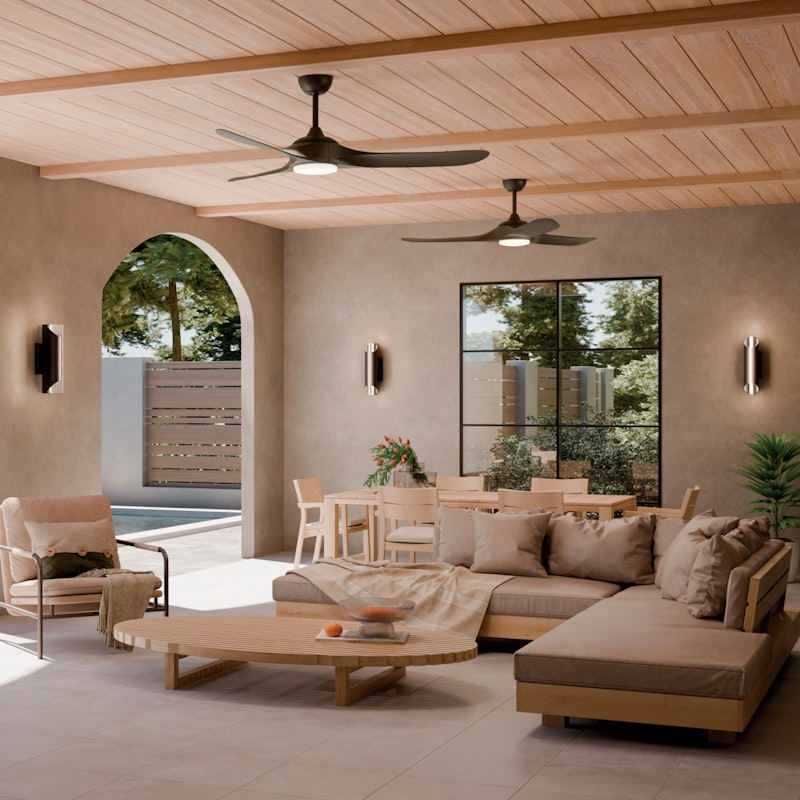
Mylo 60 Inch Outdoor Rated Ceiling Fan by Kichler Lighting
Noise Levels and Comfort Considerations
When designing spaces, many designers and homeowners tend to focus on visual elements, like the gleam of a brass canopy or the layered glow of integrated lighting. However, a room’s acoustics are just as important to comfort as its temperature. The sound profile of a ceiling fan is subtle, yet it can have a major impact on any room.
Because 3-blade fans push through the air at higher speeds, they often create a distinctive whooshing wind noise. For some homeowners, this ambient white noise is a welcome addition, especially in a home gym or a busy family room where a strong breeze is the main goal.
By contrast, 5-blade fans operate with tighter blade spacing. The shorter distance helps reduce noise from air movement, resulting in quieter, smoother operation. If you prefer silence, a 5-blade fan may provide the whisper-quiet, gentle wrap of cool air that you need for ultimate relaxation.
Style, Room Size, and Design Impact
Aside from mechanics, the look of the blade count can add character and style to any room. The number of blades makes your ceiling fan an intentional design element rather than just a functional piece.
If you’re looking for a sculptural design, 3-blade fans create wide, open silhouettes that add interest to your space. These fans can add a sleek, minimalist feel.
On the other hand, 5-blade fans offer a more classic look. They’re often chosen for traditional or formal home decor.
The key is to match your fixtures to the room’s feel.
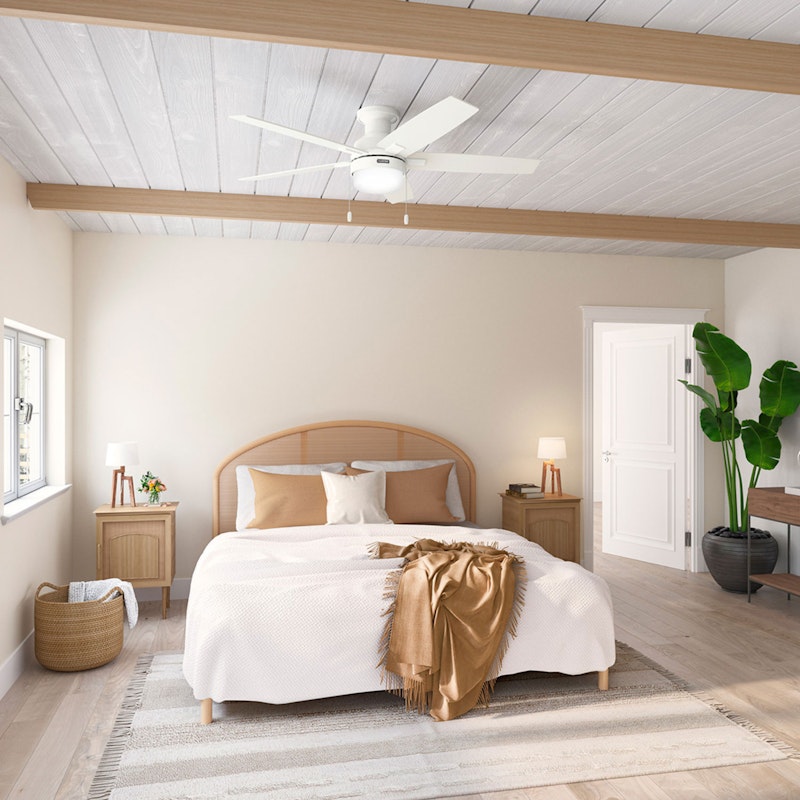
Anisten 52 Inch Flush Mount Fan by Hunter Fan
Which Ceiling Fan is Right for Your Space?
Choosing the best ceiling fan blade count comes down to personal preferences and the room’s functional requirements. There’s really no wrong choice, only the one that best fits your needs and fulfills your design vision.
When making your final decision, consider the following:
Assess the Function of Your Room
If you’re cooling a space that requires a strong, direct breeze, such as an industrial loft, the efficiency and aerodynamics of a 3-blade fan may be ideal. However, if you prefer a quiet, gentle airflow for a bedroom, nursery, or formal dining room, the buffered acoustics of a 5-blade fan may be more suitable.
Evaluate the Visual Weight
Before making a final decision, step back and take a closer look at the composition of your entire room. Does the space need a sleek, modern touch to cut through the heavy decor of traditional or antique furniture? Or do you need to add a classic, symmetrical anchor to bring warmth back to an otherwise sterile environment? Make sure the fan you choose complements other design elements.
Prioritize the Motor
Remember that blade count always comes after motor quality. Look for fans with higher CFM ratings and energy-efficient DM motors, regardless of the number of blades. You don’t want to choose a fan that increases your energy use and drives up your monthly bill.
Consider the Sensory Details
Finally, be sure to evaluate how well the fan will interact with the room’s lighting. Will the blades cast a rapid, dynamic shadow, or a slow, rhythmic pattern? Whether the fan is made of distressed oak, brushed nickel, or has a matte black finish, the materials should complement the existing textures and reflections in your space and not be distracting or stand in contrast to them.
At Capitol Lighting, we believe that bringing your vision to life should be an inspiring and deeply rewarding journey. You don’t have to sacrifice style for strategy, nor do you have to sacrifice beauty for performance. Whether you’re drawn to the refined, sculptural elegance of a 3-blade ceiling fan or the warm, classic embrace of a 5-blade design, achieving exceptional comfort and impeccable style is entirely within your reach. Trust your instincts first, and let the perfect ceiling fan elevate your home into a masterpiece of both form and function.